Ethical Dilemmas in Social Work Practice

SWCE1002 - Ethical Dilemmas in Social Work Practice

Micro-Course | 3 Continuing Education Hours | Estimated 3-Hour Workload

  • feature icon Professional Development
  • feature icon Advanced
  • feature icon 3 Continuing Education Hours
  • feature icon Estimated 3-Hour Workload
  • feature icon Self-Paced
  • feature icon Accessible for 180 days

Description

Ethics and legal issues are rarely black and white. Instead, many shades of gray are inherent to the social work profession. Knowing what to do, when, and why, and understanding the link between ethics and legal issues, are paramount to professional practice. Practicing as a social worker requires adherence to ethical codes and laws. It should be a way of being—a philosophical underpinning in your practice and an automatic part of your interactions with clients. The National Association of Social Workers (NASW) sets forth values and principles to guide social workers and social work students in their practice for social justice and empowerment of people who are vulnerable, oppressed, or living in poverty.

Reducing the incidence of ethical misconduct to the lowest possible levels is complicated, and this micro-course will help you navigate those ethical considerations as a social worker. By understanding ethical dilemmas, you should walk away from this micro-course with the knowledge to reduce ethical misconduct and how to contextual ethical principles when they may conflict in your practice.

What You Will Learn

Upon successful completion of this micro-course, you will be able to:

  • Describe the purpose and structure of the NASW Code of Ethics
  • Explain the principles of writing with legal and ethical integrity
  • Explain the purpose and ethical considerations regarding clinical documentation
  • Describe the key components of data, assessment, and plan (DAP) notes for recording individual and group sessions

Eligibility

  • Must be 18 or older

Refund Policy

You will have 24 hours, or until you receive your completion certificate, to request a full refund after purchase, whichever comes first. No hidden fees. All books and materials are included with purchase.

Faculty Bio

Curriculum

  • NASW Code of Ethics

    This section introduces the foundational framework of the National Association of Social Workers Code of Ethics. Learners will explore the core values of the social work profession, including service, social justice, dignity and worth of the person, importance of human relationships, integrity, and competence. The section emphasizes how the Code of Ethics serves as a guiding framework for professional identity, ethical decision-making, and accountability in practice across diverse social work settings.

  • Ethical Responsibility in Practice

    This section examines the application of ethical principles in day-to-day social work practice. Learners will explore how ethical responsibilities guide professional behavior, boundary management, informed consent, confidentiality, and culturally responsive practice. Emphasis is placed on ethical decision-making models and navigating complex situations where competing ethical obligations may arise in clinical and community-based settings.

  • Case Studies for Mandated Reporting

    This section focuses on the ethical and legal responsibilities associated with mandated reporting. Learners will analyze case studies involving suspected abuse, neglect, and risk of harm to self or others. The section highlights how social workers assess risk, apply reporting laws, and balance client confidentiality with legal and ethical obligations. Attention is given to documentation, professional judgment, and collaboration with protective service systems.

  • Technology

    This section explores the ethical use of technology in social work practice. Learners will examine issues related to telehealth, electronic communication, social media, electronic record keeping, and data security. The section emphasizes maintaining confidentiality, professional boundaries, and informed consent in digital environments, as well as emerging ethical challenges associated with artificial intelligence and technology-assisted practice.

  • Professional Standards

    This section reviews the professional standards that guide competent and ethical social work practice. Learners will explore expectations related to continuing education, supervision, cultural competence, documentation, and interprofessional collaboration. The section reinforces the importance of accountability, professional integrity, and adherence to the NASW Code of Ethics in maintaining public trust and advancing the profession.

Accreditation Statement

Walden University School of Lifelong Learning for the Barbara Solomon School of Social Work, provider # 1892, is approved as an ACE provider to offer social work continuing education by the Association of Social Work Boards (ASWB) Approved Continuing Education (ACE) program. Regulatory boards are the final authority on courses accepted for continuing education credit. ACE provider approval period: 9/9/2024-9/9/2027. Social workers completing this course receive 3 continuing education credits.

Walden University’s Bachelor of Social Work (BSW) and Master of Social Work (MSW) programs are accredited by the Council on Social Work Education (CSWE), a specialized accrediting body recognized by the Council for Higher Education Accreditation (CHEA). CSWE’s Commission on Accreditation is responsible for developing standards that define competent preparation for professional social workers and ensuring that social work programs meet these standards.


Criteria for obtaining Continuing Education Hours

This professional development course offers content that includes overviews and descriptions, engagement activities, resources, and a final assessment that can be taken as many times as needed to pass. Within 180 days of the course purchase date, follow these steps to claim your hours:

  1. Complete all course content,
  2. Achieve 80% or higher for the final assessment,
  3. Complete the end of course evaluation, and
  4. Download and print or save your certificate.

ADA Accommodation Statement

If you need accommodations, please e-mail [email protected].

Features

 Interactive and Engaging Content

Interactive and Engaging Content

Learn through visual, interactive, and scenario-based learning components.

 Flexible Learning

Flexible Learning

Review professional development content at your own pace to accommodate your busy schedule.

Awards

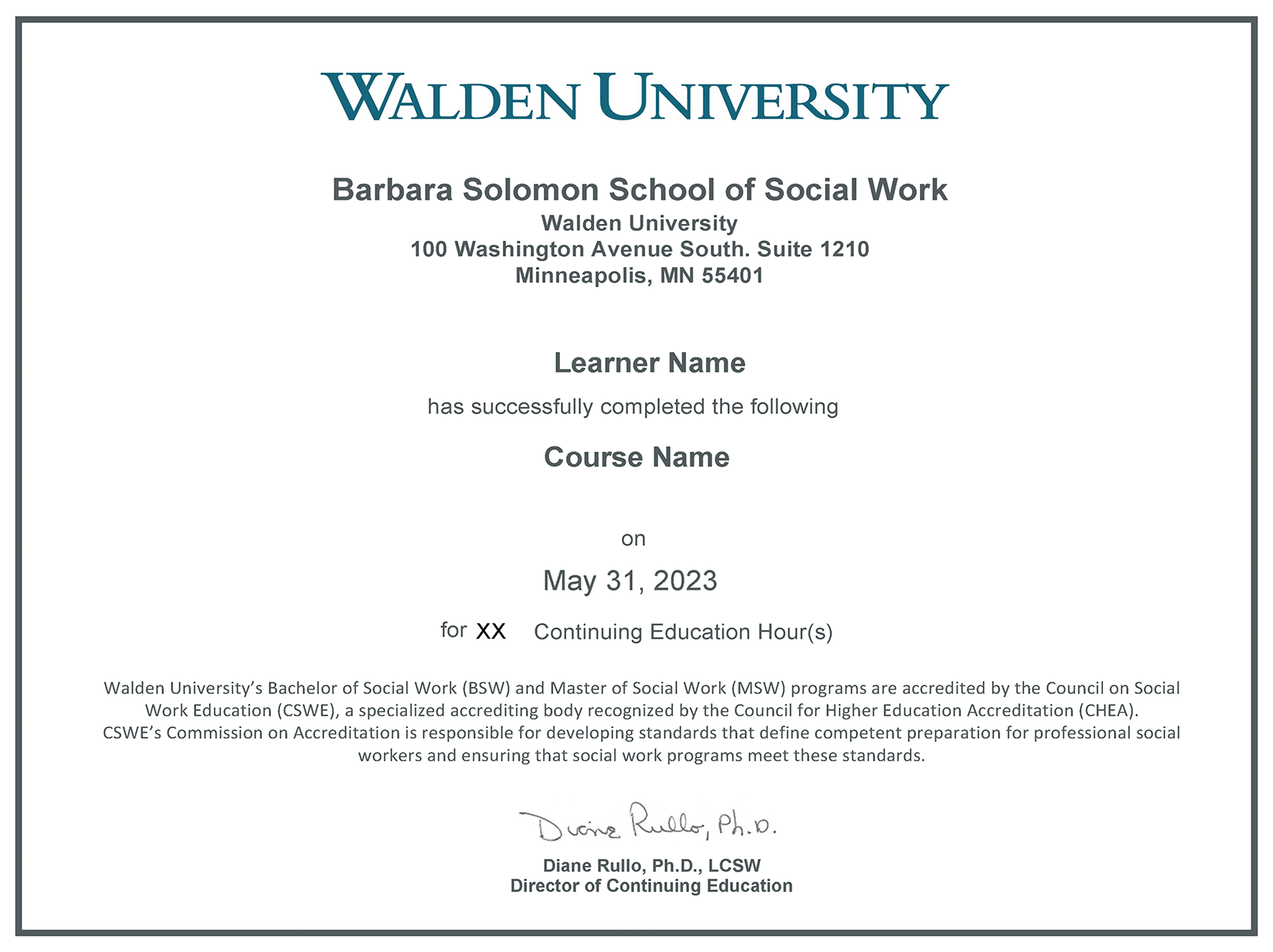
Certificate for Continuing Education Hours

Certificate for Continuing Education Hours

  • feature icon Professional Development
  • feature icon Advanced
  • feature icon 3 Continuing Education Hours
  • feature icon Estimated 3-Hour Workload
  • feature icon Self-Paced
  • feature icon Accessible for 180 days

How to enroll?

  • 1Add course to cart
  • 2Create your account
  • 3Register for course
  • 4Make payment and submit application
  • 5Start learning
-or-
Questions? Please contact [email protected]

Who is this for

  • Licensed Social Workers

Learners are responsible for consulting with the appropriate licensing, credentialing, or certifying authority; local school district; employer; or other organization to determine whether a course will be accepted by that organization. Walden does not guarantee acceptance by any third party for any specific purpose.

Recently Viewed

SWCE1002 - Ethical Dilemmas in Social Work Practice

Micro-Course | 3 Continuing Education Hours | Estimated 3-Hour Workload

SWCE1006 - Psychopharmacology for Social Workers

Micro-Course | 3 Continuing Education Hours | Estimated 3-Hour Workload