Introduction to Illicit Substances

SWCE1003 - Introduction to Illicit Substances

Micro-Course | 2 Continuing Education Hours | Estimated 2-Hour Workload

  • feature icon Professional Development
  • feature icon Advanced
  • feature icon 2 Continuing Education Hours
  • feature icon Estimated 2-Hour Workload
  • feature icon Self-Paced
  • feature icon Accessible for 180 days

Description

Substance use disorder is a complex issue that can have a devastating impact on the clients you serve. As a social worker, you play a vital role in helping people with substance use disorders seek and receive the treatment they need. Effective treatment of those with substance use disorders requires a fundamental knowledge of the various substances that could be used by current or potential clients.

Awareness of chemical compounds is the first step in treating a population that uses drugs and alcohol in a destructive way. In this course, participants will begin their journey of developing an understanding of substance use disorders by being introduced to drug categories, the diagnosis of a substance use disorder, the actions of drugs, and the regulation and classification of illicit substances.

What You Will Learn

Upon successful completion of this micro-course, you will be able to:

  • Differentiate the terminology associated with the use of illicit substances
  • Explain the diagnosis of a substance use disorder
  • Identify the neurotransmitters that interact with illicit drugs
  • Identify the action of drugs

Eligibility

  • Must be 18 or older

Refund Policy

You will have 24 hours, or until you receive your completion certificate, to request a full refund after purchase, whichever comes first. No hidden fees. All books and materials are included with purchase.

Faculty Bio

Curriculum

  • Illicit Substances

    This section introduces illicit substances and their effects on the central nervous system (CNS). Learners will explore the major categories of substances, including their physiological effects on the body and brain. The section also examines the impact of stigma, terminology, and labeling within the substance use field and how language influences perceptions of individuals with substance use disorders. In addition, participants will review the diagnostic criteria for substance use disorders as outlined in the Diagnostic and Statistical Manual of Mental Disorders, Fifth Edition, Text Revision (DSM-5-TR).

  • Action of Drugs

    This section examines the various methods of drug administration and how routes of use influence the onset, intensity, and duration of substance effects. Learners will explore the concept of drug safety margins and the risks associated with misuse and overdose, including the potential for fatal outcomes. The section also introduces common drug screening and testing methods used in clinical and professional settings. An in-depth review of the nervous system and the impact of substances on neurological functioning concludes the section.

  • Drug regulation and classifications

    This section provides an overview of the history of drug regulation in the United States and the evolution of laws and policies related to substance use and control. Learners will examine the development of federal drug legislation and its influence on public health, healthcare practice, and society. The section also introduces the drug scheduling system used in the United States, including the classification of substances based on their medical use, potential for abuse, and risk of dependence.

Accreditation Statement

Walden University School of Lifelong Learning for the Barbara Solomon School of Social Work, provider # 1892, is approved as an ACE provider to offer social work continuing education by the Association of Social Work Boards (ASWB) Approved Continuing Education (ACE) program. Regulatory boards are the final authority on courses accepted for continuing education credit. ACE provider approval period: 9/9/2024-9/9/2027. Social workers completing this course receive 2 continuing education credits.

Walden University’s Bachelor of Social Work (BSW) and Master of Social Work (MSW) programs are accredited by the Council on Social Work Education (CSWE), a specialized accrediting body recognized by the Council for Higher Education Accreditation (CHEA). CSWE’s Commission on Accreditation is responsible for developing standards that define competent preparation for professional social workers and ensuring that social work programs meet these standards.


Criteria for obtaining Continuing Education Hours

This professional development course offers content that includes overviews and descriptions, engagement activities, resources, and a final assessment that can be taken as many times as needed to pass. Within 180 days of the course purchase date, follow these steps to claim your hours:

  1. Complete all course content,
  2. Achieve 80% or higher for the final assessment,
  3. Complete the end of course evaluation, and
  4. Download and print or save your certificate.

ADA Accommodation Statement

If you need accommodations, please e-mail [email protected].

Features

 Interactive and Engaging Content

Interactive and Engaging Content

Learn through visual, interactive, and scenario-based learning components.

 Flexible Learning

Flexible Learning

Review professional development content at your own pace to accommodate your busy schedule.

Awards

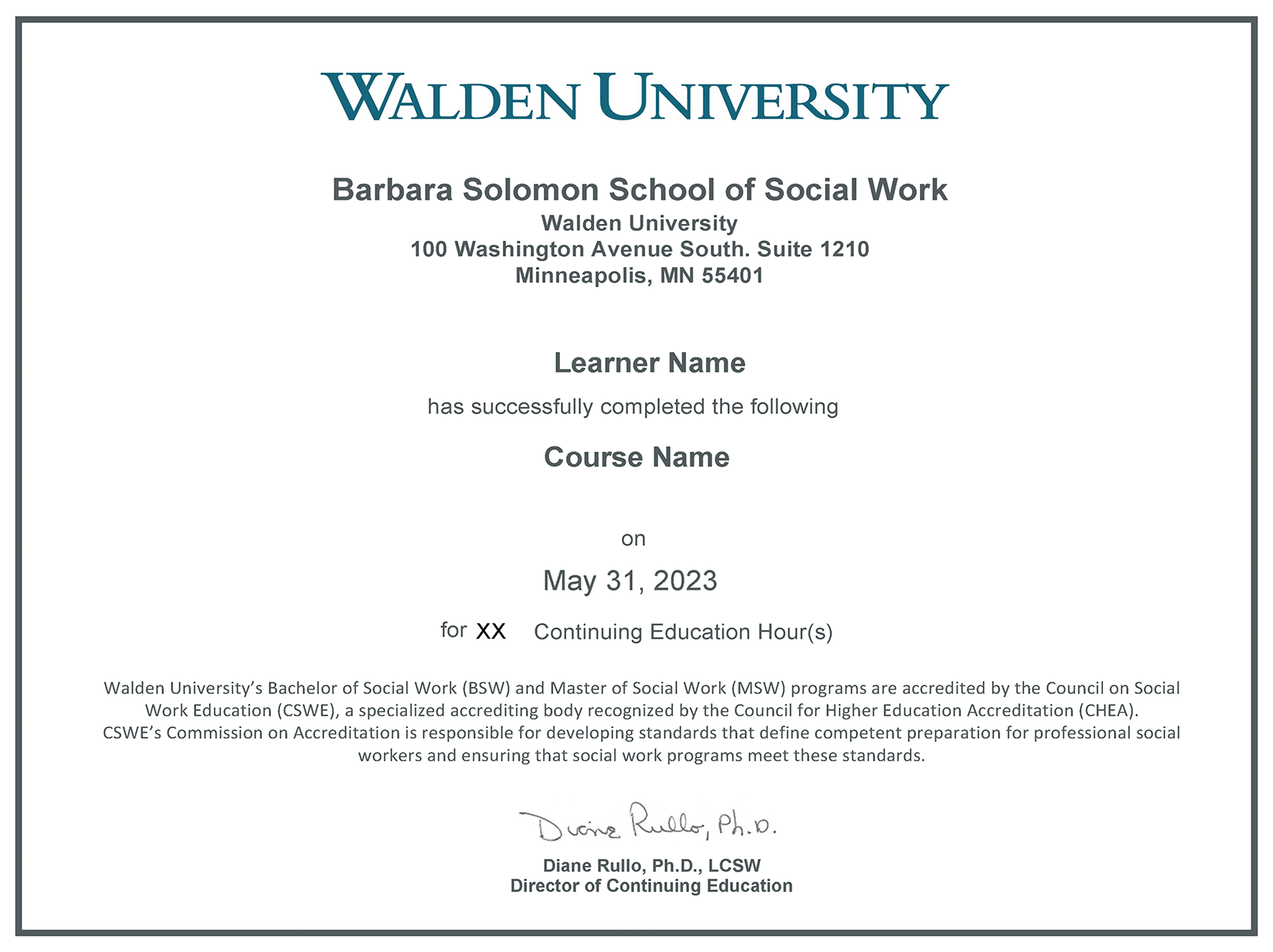
Certificate for Continuing Education Hours

Certificate for Continuing Education Hours

  • feature icon Professional Development
  • feature icon Advanced
  • feature icon 2 Continuing Education Hours
  • feature icon Estimated 2-Hour Workload
  • feature icon Self-Paced
  • feature icon Accessible for 180 days

How to enroll?

  • 1Add course to cart
  • 2Create your account
  • 3Register for course
  • 4Make payment and submit application
  • 5Start learning
-or-
Questions? Please contact [email protected]

Who is this for

  • Licensed Social Workers

Learners are responsible for consulting with the appropriate licensing, credentialing, or certifying authority; local school district; employer; or other organization to determine whether a course will be accepted by that organization. Walden does not guarantee acceptance by any third party for any specific purpose.