Hallucinogens, Cannabis, Designer and Alternative Drugs

SWCE1005 - Hallucinogens, Cannabis, Designer and Alternative Drugs

Micro-Course | 3 Continuing Education Hours | Estimated 3-Hour Workload

  • feature icon Professional Development
  • feature icon Advanced
  • feature icon 3 Continuing Education Hours
  • feature icon Estimated 3-Hour Workload
  • feature icon Self-Paced
  • feature icon Accessible for 180 days

Description

Hallucinogens, cannabis, designer drugs, and alternative drugs are a diverse group of substances that can produce a variety of effects on users. As a social worker, you may encounter clients affected by or struggling with substance use disorder related to these diverse substances.

In this micro-course, you will study substance use disorders of the drug categories of hallucinogens, cannabis, designer drugs, and alternative drugs. You will learn to categorize and distinguish between these various substances, including their chemical compounds and the effects they have on the user’s mind and body. You will also explore the impact of these substances on the individuals using them and their families and communities.

What You Will Learn

Upon successful completion of this micro-course, you will be able to:

  • Identify the significant categories of addictive substances: hallucinogens, cannabis, designer drugs, and alternative drugs
  • Describe widely used hallucinogens, cannabis, designer drugs, and alternative drugs
  • Identify forms of use, potential effects of use, and potential consequences of use of hallucinogens, cannabis, designer drugs, and alternative drugs

Eligibility

  • Must be 18 or older

Refund Policy

You will have 24 hours, or until you receive your completion certificate, to request a full refund after purchase, whichever comes first. No hidden fees. All books and materials are included with purchase.

Faculty Bio

Curriculum

  • Hallucinogens

    Depressants and their effects on the central nervous system (CNS) are introduced. Learners will examine commonly used depressants, including alcohol, benzodiazepines, barbiturates, and sedative-hypnotics, with attention to their physiological and psychological effects. The section also explores tolerance, dependence, withdrawal symptoms, overdose risks, and the impact of depressants on behavior, cognition, and overall functioning.

  • Cannabis

    Stimulants and their impact on the body and brain are examined. Participants will review substances such as cocaine, amphetamines, methamphetamine, nicotine, and caffeine, focusing on their mechanisms of action and effects on energy, mood, alertness, and cardiovascular functioning. The section also addresses patterns of misuse, psychological and physical dependence, withdrawal symptoms, and the short- and long-term consequences associated with stimulant use.

  • Designer Drugs

    This section provides an overview of opiates and opioids, including prescription pain medications, heroin, fentanyl, and related substances. Learners will explore how these substances interact with the brain and nervous system to produce pain relief and euphoria while also contributing to tolerance, dependence, and addiction. The section discusses the opioid epidemic, overdose risks, signs and symptoms of opioid use disorders, withdrawal processes, and evidence-based approaches to treatment and recovery.

  • Alternative Drugs

    This section explores alternative drugs, including inhalants and other non-traditional substances that are often easily accessible and widely misused. Learners will examine common inhalants such as solvents, aerosols, gases, and nitrites, with emphasis on their toxic effects on the brain, cardiovascular system, and other organs. The section also discusses patterns of use, especially among adolescents, as well as the serious risks of long-term damage, sudden death, and cognitive impairment associated with these substances.

Accreditation Statement

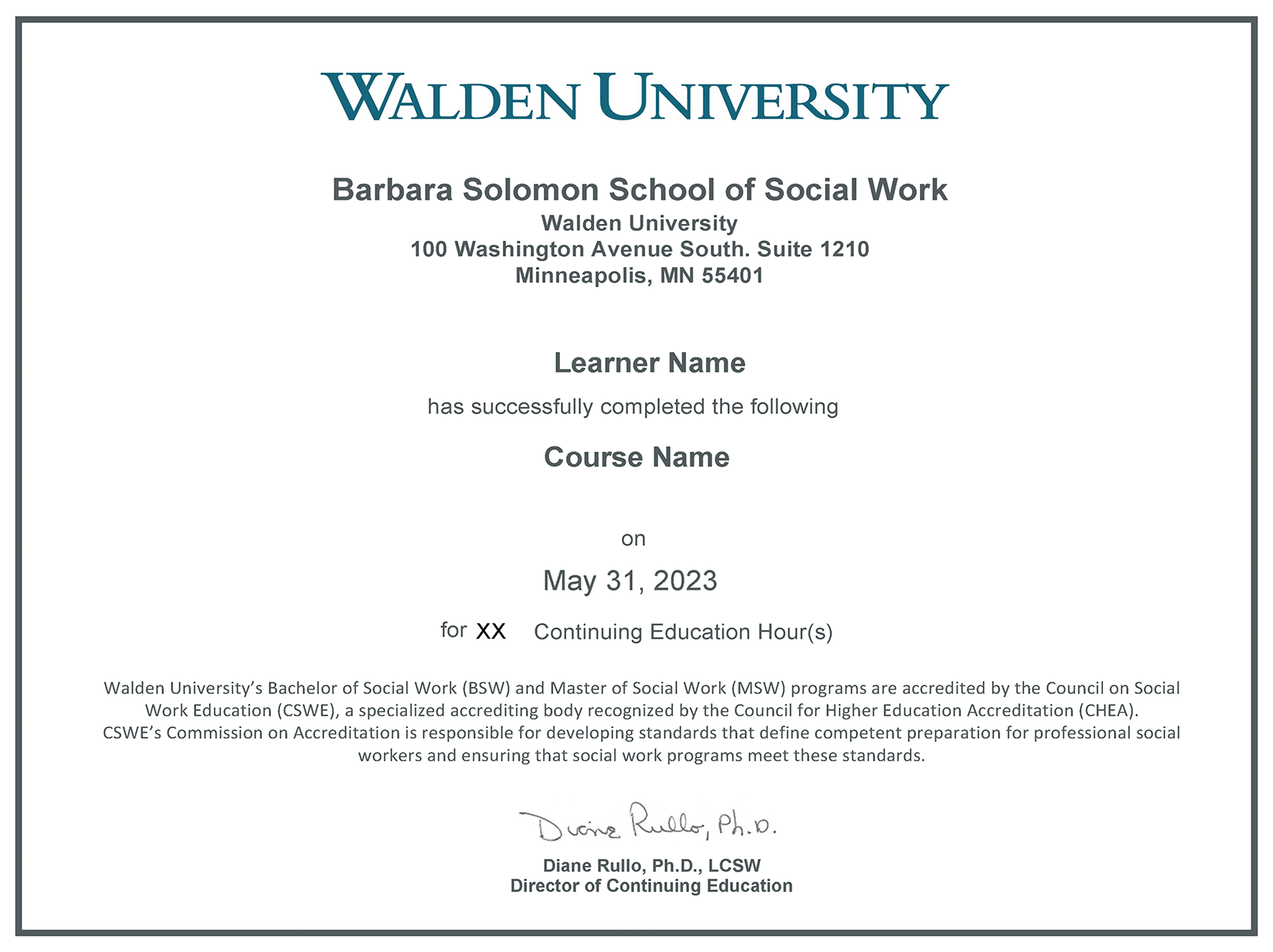
Walden University’s Bachelor of Social Work (BSW) and Master of Social Work (MSW) programs are accredited by the Council on Social Work Education (CSWE), a specialized accrediting body recognized by the Council for Higher Education Accreditation (CHEA). CSWE’s Commission on Accreditation is responsible for developing standards that define competent preparation for professional social workers and ensuring that social work programs meet these standards.


Criteria for obtaining Continuing Education Hours

This professional development course offers content that includes overviews and descriptions, engagement activities, resources, and a final assessment that can be taken as many times as needed to pass. Within 180 days of the course purchase date, follow these steps to claim your hours:

  1. Complete all course content,
  2. Achieve 80% or higher for the final assessment,
  3. Complete the end of course evaluation, and
  4. Download and print or save your certificate.

ADA Accommodation Statement

If you need accommodations, please e-mail [email protected].

Features

 Interactive and Engaging Content

Interactive and Engaging Content

Learn through visual, interactive, and scenario-based learning components.

 Flexible Learning

Flexible Learning

Review professional development content at your own pace to accommodate your busy schedule.

Awards

Certificate for Continuing Education Hours

Certificate for Continuing Education Hours

  • feature icon Professional Development
  • feature icon Advanced
  • feature icon 3 Continuing Education Hours
  • feature icon Estimated 3-Hour Workload
  • feature icon Self-Paced
  • feature icon Accessible for 180 days

How to enroll?

  • 1Add course to cart
  • 2Create your account
  • 3Register for course
  • 4Make payment and submit application
  • 5Start learning
-or-
Questions? Please contact [email protected]

Who is this for

  • Licensed Social Workers

Learners are responsible for consulting with the appropriate licensing, credentialing, or certifying authority; local school district; employer; or other organization to determine whether a course will be accepted by that organization. Walden does not guarantee acceptance by any third party for any specific purpose.